Lunch policy-can I work through lunch?

I enjoy talking about policies and whether or not policies are necessary. Recently someone asked me what I thought about a policy on working through lunch. The phrasing led me to believe that their employees were working from their desks while eating (and by working I mean surfing the web).

So, with that in mind, did I recommend a “no eating at your desk rule?”

No.

I encouraged my friend to look at the situation in the context of job performance. If employees are completing work and abiding by the rules, leave them be. On the other hand, if it is affecting performance by causing them to not finish their work on time, have more mistakes, etc., then approach the situation from that legitimate standpoint.

A follow up comment by my friend was that the policy would be “too hard to manage” if done piecemeal, so it should be a flat ban across the board if it went into effect. My response was that people choosing to eat at their desks or not isn’t something that really requires management (or attention) unless it impacts their level of performance.

This isn’t 1910. We don’t have to stand over people every minute of the day to “crack the whip” and make them work. If you do, then you have larger problems on your hands.

Focus more on what is accomplished and less on the how.

What are your thoughts?
What does HR certification cost?

The cost of HR certification isn’t great, but the value is what you make of it. The letters behind your name can be just one more thing for you to have to keep track of, or they can be a leverage point for finding a better job, getting a promotion, or growing in your current position.

I shot this video a while back as a special bonus for people who sign up for the free PHR/SPHR email newsletter, and I wanted to share it with you guys. Lots of SHRM chapters (ours included) have certification prep classes on their Spring calendars. My friend Bobbi is the one running the program for NASHRM, and it’s going to be pretty awesome. Wondering how getting certified can impact your career? Check out the video below.

Email subscribers will have to click through to view the video.

Informal peer recognition

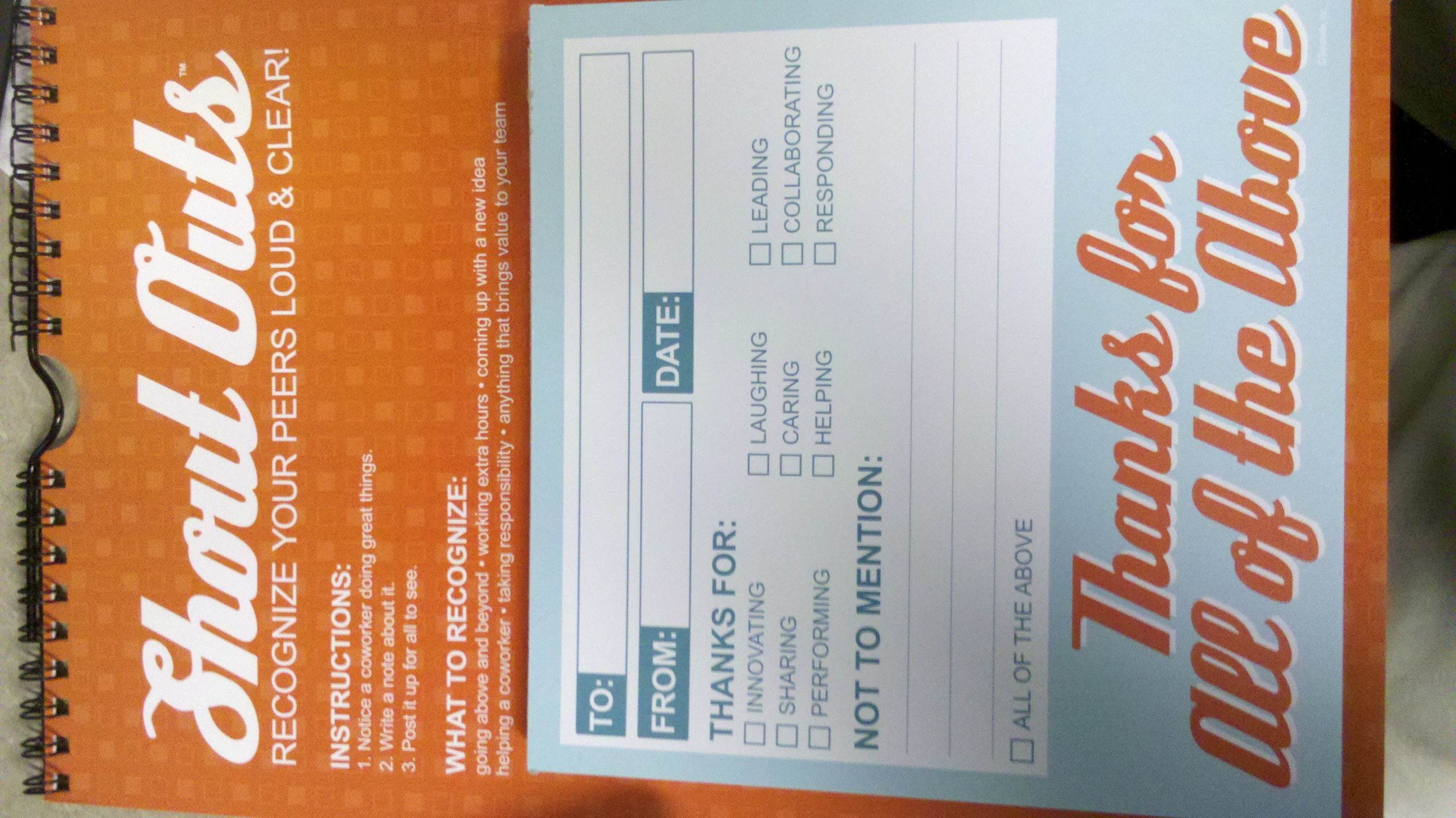
informal peer recognition toolMy friend Cori at Baudville sent me this cool tool for peer to peer recognition the other day. I’m itching to try it out. When I head to our off site location later this week I’ll be delivering it and offering some encouragement/guidance to our on site HR person to get it rolling.

Peer recognition in a nutshell

The basic idea is that much of the stuff that gets done isn’t obvious to managers, so having peers recognize each other covers those “unseen yet praise-worthy” actions.

There’s also the fun element which shouldn’t be underestimated. I love telling others how awesome they are for doing something extra special. The only way to make that even more fun is to do it when others can see and hear about their accomplishment. That not only earns them some extra kudos, but it also increases the likelihood that they will make that type of action a habit.

Do you have some sort of peer recognition program at your company? It can be as informal as a bulletin board for notes or as formal as a reward program where you get recognized in some sort of ceremony. Love to hear how others do this!

New Hire Orientation eBook

new hire orientation free ebookOnboarding. New hire orientation. If you’ve been through a bad experience, you know how important this stuff is. Conversely, if you’ve been through a great experience, you know how important it is to help you feel connected to the organization and people from the very beginning.

Introducing the New Hire Orientation and Onboarding eBook

Recently I reached out to a few people to see if they wanted to contribute to an eBook to help HR pros, managers, and business leaders learn more about these topics. The response was a good one, and today I’m happy to share the free eBook with you. It’s titled “So, what’s next? A guide to onboarding and new hire orientation.”

There are three loose groups of articles in the book. First you’ll hear some stories about new hire orientation gone bad. Next you’ll learn some tips and ideas on how to do it the right way. And finally there are a few pieces on the unique challenge of onboarding new managers.

Special thanks to Shauna Moerke for helping me to promote the guide through the HR Carnival channel. I also want to thank the contributors for offering up some great, useful content: Paul Smith, Jennifer McClure, Trish McFarlane, Laura Schroeder, Dwane Lay, Dave Ryan, Lance Haun, Charlie Judy, Robin Schooling, Sabrina Baker, Michael VanDervort, and Tanmay Vora. You can find links to each of these contributors’ websites within the guide.

Click here to download So, what’s next? A guide to onboarding and new hire orientation

2%-What\’s it to you?

I wrote this piece for our company newsletter recently. I’m a big believer in educating our employees on the importance of saving for retirement, and when I heard about a new tax change this year, I just knew I had to write on it. If you are interested in using it for your own company, feel free to copy/paste this post for your people. Enjoy!

2%-What\’s it to you?

If you hang around the financial news section, then you might have heard something about a change in your withholding taxes for 2011. Why does this concern you? Well, according to CNN Money, only 16% of people are confident in their ability to save for retirement. It\’s frightening to hear news like that, but there is a positive side to this situation.

To adequately prepare their finances for the golden years, Americans need to be saving 6-10% of their salaries throughout their working lives. If you are investing in your 401(k) account to the full match (average company matches 3%), then you are barely reaching the bottom end of the spectrum.

So, what does this have to do with the change in taxes this year? Well, as a result of one of the new laws by Congress, 2% of your normal social security payroll taxes will not come out of your check this year. If you\’ve been holding off on participating in the 401(k) program, now\’s the time to make the leap! If you already contribute, this is a great way to bump up your contribution to make sure you are adequately covered in your retirement savings.

Here\’s a quick example of the power of 2%. If an employee makes $50,000 per year and puts this 2% ($1000) into an average mutual fund in their 401k account for 25 years without adding anything else in that time, that would total more than $17,000. If you\’re not currently participating in the 401k program and that 2% election is eligible for matching, that could double the amount to $34,000. Not enough to retire on, but not something to sneer at, either.

If you\’re interested in learning more, joining the 401(k) program, or just figuring out what is right for you, feel free to contact your plan administrator for assistance.

What do you think? Good? Bad? Ugly? :-)

Working with nuts, fruits, and M&Ms

So I heard that the HR Carnival for this upcoming week was going to be focused on food and HR. For some reason my brain defaulted to comparing the characters in every workplace with a bag of trail mix. Check out the short (kinda funny!) video below for more.

Email subscribers click through to view.

Notes

  • Ain’t Bella the cutest? :-)
  • Fruits-they have been around forever, they are kind of sour, and even if we don’t enjoy them they are pretty boring and don’t rock the boat
  • M&Ms-these are the best part of the whole batch, but just like in life, we only have a limited number of M&Ms (aka star employees) to work with
  • Nuts-the nuts make up the bulk of our workforce, they have their little quirks and we spend most of our time dealing with this group

Okay, so it was a fun little exercise. Want to tell a story about a “nut” in your own workplace? I’d love to hear it!

Illegal interview questions and manager training-Guest Post Blitz #9

What do illegal interview questions, video training for managers, and required reading lists for employees have in common? They are all guest posts I’ve done in the past little while! Looks like I’m a little schizophrenic with the varying topics, but each post has its own merits.

These guest posts went live (fairly recently) elsewhere that you may have missed. Some of them might be a bit different flavor than the usual upstartHR offerings, so be sure to check them out! If you\’re interested in seeing some of my previous escapades, click here for the Guest Post Blitz archive.

Here’s a new hire program I can get behind. Employees are required to read books as a way to introduce them to the culture and encourage them to keep professional development on their radar. Thanks to Matt at Monster Thinking for letting me share!

My friend JT at Careerealism shared this question with me and I just couldn’t pass it up. It sounded like an episode of Jerry Springer and the title is “Can I get fired for this?” The funny thing is I had to read the question ten times and diagram the situation so I could understand and respond.

Ever wondered if those interview questions about when you graduated school are actually legal? I hit on that in this post for Careerealism. (Hint: the question itself isn’t illegal, it’s what you do with it that counts).

This one’s so new it still has the bubble wrap on it. I ran into a snag when I was looking at developing a social recruiting plan for my employer. Apparently social recruiting doesn’t work for everyone. Would love some comments on this one.

Over on RocketHR I posted about creating and distributing video training for managers on an as-needed basis. Having trouble with conflict resolution? Send them the video with some tips and tricks to doing that better. Need some assistance with giving feedback to staff? There’s a video for that one, too.

And finally, I’ve had a lot of comments in person on this post about who is HR’s customer. Is it the employee? The manager? The job candidate? Senior leadership? The garbage man? Yeah, there are a lot of facets to consider and this one isn’t a simple question to answer.