Today we’re going to explore the intersection of creativity, innovation, and intrapreneurship (entrepreneurial activities occurring within an organization) and how these activities bring value to the business world. I hope you enjoy!
Innovation is a curious thing. In a research report published by the International Board of Innovation Science, Dennis Stauffer explored what separates wildly successful companies from the rest. Here's a quote from the article that sheds light on the extent to which innovation drives value:
The research with entrepreneurs is especially noteworthy because it revealed the dramatic impact that this measure of innovativeness has on value creation. When those founders who scored highest on the Innovativeness Index were compared to those who scored lowest, the ventures of the high scorers averaged 34 times as much profit, 70 times as much revenue and employed 10 times as many people. They were also dramatically more likely to be one of the exceptionally high performers that investors call a “home run†(defined in this study as having achieved at least a million dollars in annual profits).
Companies everywhere are trying to create more innovative atmospheres for employees. But what if the answer isn't open office space or an office beer cooler, but a higher engagement score?
Research by Gallup found that 61% of engaged employees feed off the creativity of their colleagues, compared to a mere 9% of disengaged employees. In addition, it found that 59% of engaged employees believe their job brings out their most creative ideas, compared to only 3% of disengaged employees.
Finally, are you familiar with the intrapreneur? This conversation will also touch on this type of person/personality and I want to make sure we’re on the same page.
Intrapreneurs are usually employees within a company who are assigned to work on a special idea or project, and they are instructed to develop the project like an entrepreneur would. Intrapreneurs usually have the resources and capabilities of the firm at their disposal.
You can imagine the value of someone that takes ownership, manages a project like it was their own business, and seeks acceptable risks. But it requires a foundation of trust to make it work, and we can easily measure the value of that aspect: a recent Watson Wyatt study showed that high trust companies outperform low trust companies by nearly 300%!
All of these data points just go to show that creativity and innovation are incredibly valuable. The problem is that many companies are not at all prepared to manage people that fit the creative profile. Even those that say they want a workforce full of ideas and innovation usually back away once they realize the effort it takes. At the same time, you saw some of the research that shows the value of innovation in the workplace. While it might take some work, hiring these kinds of people can also provide amazing benefits for companies that are willing to commit.
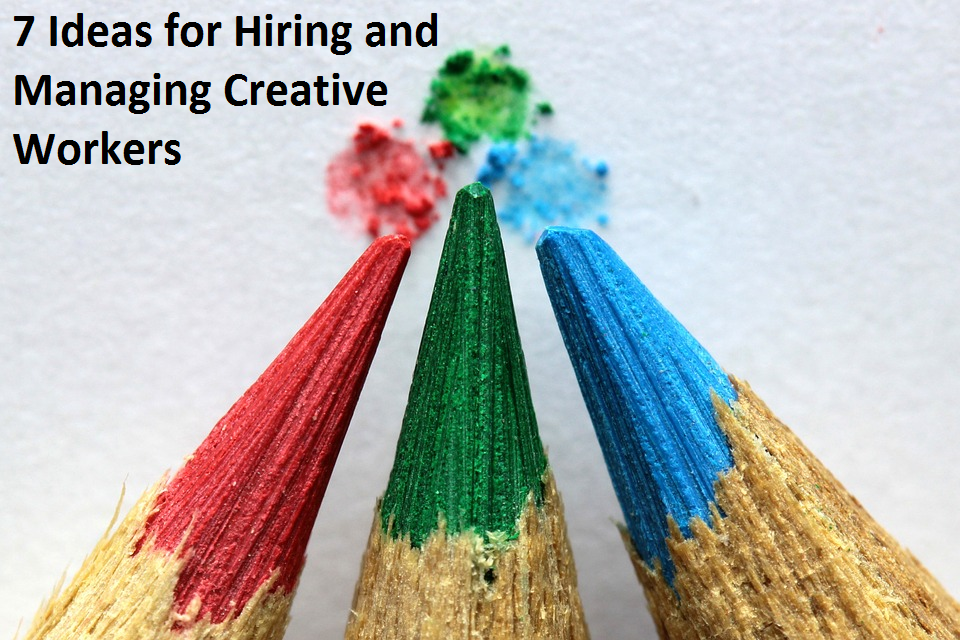
Throughout this article we’re going to explore seven opportunities to help with hiring and managing creative people.
- Prepare for creative tension
- Seek wanderers
- Test their big picture thinking
- Encourage some nonconformity
- Let people share and vote on ideas
- Don’t hire “idea” people if you don’t plan to use their ideas
- Don’t treat creatives just like everyone else
Creative Tension is a Reality
People that are creative have a different way of seeing the world, and companies are often not set up to accept and embrace that kind of thinking. On the flip side, some companies seek out these types of people because they understand the value they can bring. A Boulder, Colorado-based marketing firm, Kapost, does just that. Here’s a snippet about their approach:
Recruiting, engaging, and retaining entrepreneurial employees depends in large part on a manager's ability to discuss and facilitate career development. However, recruiters, managers, and executives are often poorly-equipped to lead these conversations. Toby Murdock, the founder and CEO of Boulder-based content marketing company Kapost, set out to fix that. His goal: to make his company the best place in Colorado to launch and accelerate a career in high tech. Â Thanks to a compelling employee value proposition around career transformation, Toby has successfully recruited entrepreneurial employees into the company who might have otherwise been out of reach.
Consider that. Instead of being afraid of the turnover of losing those entrepreneurial employees a few years down the road, the CEO of Kapost decided to embrace it and reap the benefits of having those people working under his direction.
Research shows that 70% of entrepreneurs left the corporate world because they were too confined. I know that’s the case for me. Creative tension can either be painful and stressful on both parties, or it can be harnessed to develop innovative solutions to problems both small and large. Innovation matters.
An Accenture study of 500 US, UK, and French companies showed that 70% of executives considered innovation to be among the top five strategic priorities, and 67% said they are highly dependent on innovation for long-term success. However, less than one in five said they had realized a competitive advantage from their innovation strategies because they were too risk averse to take advantage of the potential opportunities. Hint: this is a problem, and it doesn’t exist solely in enterprise organizations.Â
Seek Wanderers
I’m currently reading IGNITE: Setting Your Organization’s Culture on Fire with Innovation by Moss and Neff. It’s really good and full of stats and stories about how the authors have used and seen innovation in practice. One of the sections talks about how to hire intrapreneurial employees, and the authors encourage seeking “wanderers,” or people that are more likely to be curious, in the hiring process. The example the authors give is asking about a recent conference a candidate attended. Was it an assignment, or did the person request to attend? What session was their favorite? What takeaways or pieces of information did they collect? How have they implemented it at work?
In another book (yes, you know I’m a book nerd) about the history of Chick-Fil-A, the founder Truett Cathy talks about the company’s approach to hiring store Operators. He says that the company would rather restrain mustangs than kick mules, or he’d rather have to pull back on the reins of someone that is going too fast than try to push someone that is going too slow.
Back in 2009 when I helped to start the HRevolution movement, this “wandering” mentality is what drove us to do so. The event appeals to people that want something more than a “sit in the back of the room and play on your phone” type of conference. People come expecting to contribute, share, and explore ideas collaboratively. And for those that take advantage of it, the value is immense.
Test Big Picture Thinking
One of the other hallmarks of an entrepreneurial employee is being able to see the big picture. Instead of being aware only of the minute fraction of the business that the person touches day to day, the mindset of one of these individuals can see how the job affects people both up and down the line.
In the interview, the authors of IGNITE recommended offering someone a whiteboard to explain an idea or explore a complex process. They posit that the more creative individuals will be able to accomplish the task.
What I would also encourage focusing on is a bit of QBQ-like interactivity. If you’re unfamiliar, QBQ stands for the Question Behind the Question. QBQ is one of the required books new employees working at my favorite radio host’s company must read. The QBQ process is used to help get beyond the normal questions we see in the workplace:
- Whose fault is this?
- Why wasn’t this done correctly?
- How long until things get better?
We want to get beyond those poisonous questions to some that are more engaging and solution-focused, like these:
- What can I do to help?
- How can I make sure this is done correctly?
- What can I do to make things better?
In the interview, ask the person some questions around the QBQ mindset. Present them with a problem and then ask for some QBQ-like questions that show that they are able to see the big picture and can understand how to impact results positively.
Encourage Nonconforming Behaviors
I’ve been reading a lot about conformity and finding the right ways to encourage some creative rebellion among employees. One recent piece from Harvard Business Review lays out an interesting picture of the state of conformity at work:
Of course, not all conformity is bad. But to be successful and evolve, organizations need to strike a balance between adherence to the formal and informal rules that provide necessary structure and the freedom that helps employees do their best work. The pendulum has swung too far in the direction of conformity.
In another recent survey I conducted, involving more than 1,000 employees in a variety of industries, less than 10% said they worked in companies that regularly encourage nonconformity. That's not surprising: For decades the principles of scientific management have prevailed. Leaders have been overly focused on designing efficient processes and getting employees to follow them.
Now they need to think about when conformity hurts their business and allow — even promote — what I call constructive nonconformity: behavior that deviates from organizational norms, others' actions, or common expectations, to the benefit of the organization.
To illustrate a behavior or choice that falls outside common expectations, let’s examine a story from Southwest Airlines. A few years ago a very junior employee was working as a gate agent when a flight was rerouted due to weather, stranding the passengers who were almost to their final destination. The common response was to apologize and hold out until the next day, hoping for better weather. Instead, she chartered three buses to take the people home, getting them to their destination in just a few hours.
Herb Kelleher, then-CEO of Southwest, brought her to the headquarters to meet with him. Instead of chastising her for not following protocol, Kelleher praised her quick thinking and dedication to doing the right thing by the customers. That kind of praise not only rewards the employee, but demonstrates to others what kinds of behaviors are expected as well.
Offer Idea Sharing/Voting
One of the simple ways to take advantage of what these employees have to offer is to let them contribute, share, and vote on ideas. I’ve talked in the past about the “Big Ideas Database” that we used at a former employer to allow employee-generated contributions to challenge the status quo and offer opportunities for innovation. We used a simple Sharepoint site to facilitate the process, approvals, and workflow, but there are also tools in the HR technology marketplace that can help to make this sort of process a reality. If you want to check one out, why not start with Tembostatus or Waggl. Anyone can contribute ideas, share, vote, comment, etc.
Whatever the method, the value is in leveraging employee ideas for innovation. Check out this video for an example of how this kind of employee-driven innovation can benefit an organization’s revenue, customer satisfaction, and more.
Plan to Use the Ideas You Get
While not every idea that comes in will be valuable, you need to truly make an effort to accept some of them. I’ve been faced with this at several of my previous employers. I was born with an eye for problem solving–I can’t turn that off. And I can think specifically of instances at two previous employers where I had heard a “no” one too many times and that facilitated my change of employment. The crazy part is that during the recruiting process, those companies recognized and appreciated those kinds of thoughts. They told me that they wanted suggestions, ideas, and contributions.
However, once I was “inside the fence” and employed with them, it was a different story. When I speak I often tell about the employer that failed just a few months after I left. One of the last conversations with my manager was a list of ideas about how we could fix the 40+% turnover problem that was draining our budget faster than we could survive, and the response was “get back to work processing those new hires and terminations.” Ouch.
As far as how many ideas you need to implement, that’s where it can be a bit fuzzy. I saw an article recently about a large telecommunications company that received more than 10,000 employee ideas and had implemented less than 100. I don’t have a benchmark to know if that’s good or bad, but for those other 9,900 ideas, you need to be sure that those people feel like their contribution mattered.
Treat Creatives Differently
We use a few terms to describe different types of employees under our charge:
- High performers
- High potentials
- What about high innovators or high creatives?Â
Whatever label we stick on them, we need to treat them differently from the rest of the employees. Yes, this scares the pants off most HR pros, because we’ve been taught to treat everyone the same. But it’s madness when you think about it. Equal treatment for unequal performance/productivity/contributions is a surefire path to mediocrity.
Consider this analogy of tire pressure equalization. A tire works because it captures air and builds pressure, allowing it to hold its shape and move a vehicle around (a high value activity).
Those creative people in your organization are the high pressure air inside that make the value possible. Treating all employees the same is like putting a hole in the tire. Eventually all the high pressure air leaks out (employee turnover), and low pressure leaks in (hiring for conformity, not creativity), until you have something that doesn’t offer value.
That’s how companies achieve mediocrity every day. If you’re interested in being a mediocre HR leader at a mediocre company with a mediocre track record, make sure you treat all employees the same, regardless of their contributions. Back to those companies that I worked for previously, that was why both of them will never be truly exceptional. All employees were treated the same by the company’s owners, which led the creative, valuable people to leave. Those that didn’t do extra work, look for ways to contribute beyond their job titles, and seek opportunities to grow the business? They stuck around. Ouch.
Take Baby Steps
As you begin this journey, take small steps and always stay just a bit uncomfortable. Knowing how to hire creative people is one thing. Knowing how to manage creative people is something else entirely. Look for ways to encourage creative, nonconforming ideas from your people at regular intervals. And don’t forget the seven strategies that can make it work for you:
- Prepare for creative tension
- Seek wanderers
- Test their big picture thinking
- Encourage some nonconformity
- Let people share and vote on ideas
- Don’t hire “idea” people if you don’t plan to use their ideas
- Don’t treat creatives just like everyone else
How does your organization encourage and support creative employees? What value do you see this population bringing to your business?Â

 Personally, it has opened my eyes to other perspectives and helps to give context to the conversations I am having with leaders that are trying to create more inclusive workplaces.


 I’m reading a
  First up, stories are powerful. I think we all know that (and I’ve talked about it both